When training multiple dogs, a reliable three-dog shock collar system helps keep each pet’s training consistent and under control. This guide highlights five top three-dog options, outlining who each product is best for, any limitations, and why you might choose one over another. Ideal buyers include multi-dog households, kennels, or active owners with varying dog sizes. Below is a quick summary table of the featured models to compare at a glance.
| Product | Best For | Key Benefit | Limitations |
|---|---|---|---|
| HRRVEE 3 Dog Shock Collar (4,400 ft) | All sizes, outdoor training | Long range with 4 channels; memory function | 4 modes may be overwhelming for beginners |
| PetJoy 3-Dog Bark & Training Combo | Independent or simultaneous control | 2 control modes; versatile for barking and training | Remote reliance for automatic mode |
| Heaflex 3-Dog IPX8 Collar | Water-friendly training | IPX8 waterproof; 3-dog compatibility | Remote not waterproof |
| PetJoy 3-Dog with Lockable Shock | Busy households; safety-minded | Shock lock, slide safety, 9 tones | Limited detail on range |
| Jugbow 3-Dog Shock Collar | Families training in open spaces | 4 training modes; up to 4500 ft | Conversion to non-shock may require adjustment |
HRRVEE 3 Dog Shock Collar With Light

The HRRVEE 3 Pack supports dogs from 5 to 150 pounds with necks measuring 7 to 28 inches. It offers 4 training modes—beep, vibration, safe shock, and a Boost option—across 4 channels. The remote covers up to 4,400 feet and memory function preserves settings across sessions. Best for multi-dog households with outdoor training needs, especially where you want a visible light feature for nighttime locating.
Best for: Owners training three dogs with varying sizes who need a long-range setup and the option to train multiple dogs simultaneously or separately. Caution: beginners should start at low shock levels and gradually adjust to avoid overstimulation.
PetJoy Shock Collar For 3 Dogs
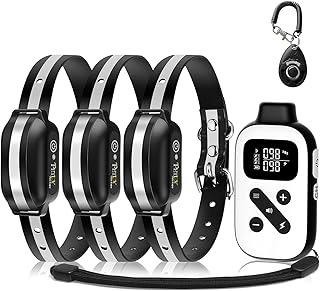
The PetJoy 3-Dog system emphasizes two control modes: separate or simultaneous control, with modes tailored to barking and training needs. It provides a remote and automatic modes alongside 4 training options: adjustable shock, vibration, beep, and auto modes. Best for: households needing flexible multi-dog management with a focus on bark control. Limitation: automatic mode relies on internal programming and may require fine-tuning to match each dog’s temperament.
Heaflex Dog Shock Collar With Remote
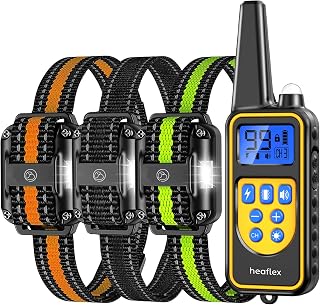
The Heaflex 3-dog system features 4 training modes including LED light, vibration, and a broad 0–99 level shock range. It uses IPX8 waterproof collars and a remote that operates up to 3 dogs on a single set. Best for: owners who need a waterproof setup for outdoor or rainy-day training. Caution: the remote itself is not waterproof, so extra care is needed when training near water.
PetJoy Shock Collar 3 Dogs With Lockable Shock

This PetJoy model supports training three dogs separately or together with a remote. It features Slide Safety Lock to prevent accidental electric shocks, 9 tones, 16 vibration levels, and 99 shock intensities. Best for: multi-dog homes seeking strong safety features and straightforward switching between modes. Limitation: some users may need to acclimate to the longer-range shock intensity scale for different dog sensitivities.
Jugbow Shock Collar For Dogs 3 Pack

The Jugbow system offers 4 training modes for three dogs with a maximum 4,500-foot range. It can control 2 collars independently with one remote, and features a memory function for ease of use across sessions. Best for: families training in open spaces where dogs roam farther apart. Caution: some families may prefer a dedicated single-dog remote for highly sensitive pets to avoid cross-interaction.
Buying Guide
What range do you actually need?
Consider your training spaces. Long-range collars (2,500–4,500 feet) are ideal for parks and large yards, while shorter ranges work well for indoors or fenced areas.
How many dogs need simultaneous control?
If you manage three dogs, a 3-dog system with 4 channels or separate pairing options helps prevent cross-talk between dogs during training sessions.
What levels of safety and control are essential?
Look for features such as lockable shocks, tone and vibration options, and a memory function to preserve settings across sessions. Waterproofing is important for outdoor use, but confirm whether the remote or receiver is protected from water exposure.
How adjustable should the training modes be?
A system with 4–5 modes (beep, vibration, various shock levels, and boost or auto modes) provides flexibility for different dog temperaments and training goals. Ensure it’s easy to customize for each dog.
Is there a risk of accidental activation?
Simple safety features like a slide lock on the remote reduce accidental shocks during transport or handling. This is particularly valuable for busy households with multiple dogs and constant movement.
FAQ
- Can I use a three-dog shock collar for puppies? Yes, but start with the lowest stimulation levels and monitor responses closely to avoid overstimulation.
- Are these collars safe for all dog sizes? Most models specify weight and neck-size ranges; choose a collar that fits your dog’s measurements for safety and effectiveness.
- What happens if two dogs receive signals at the same time? With multi-channel systems, you can train dogs separately or together, so signals are directed to the intended dog when set up correctly.
- Is waterproofing essential? For outdoor or water-risk environments, IPX8-rated collars provide better protection for long sessions or rain days.
- Can I convert a collar to no-shock? Some models offer a no-shock option by setting the stimulation level to zero; however, verify this feature before purchase.
- How do I choose between remote-only vs. automatic modes? Remote control offers precise, trainer-driven corrections; automatic modes can assist in barking control but may require more careful monitoring for each dog’s temperament.