Discover reliable automatic fish feeders that keep your aquatic pets well-fed while you’re away. This guide highlights five top-rated options, detailing capacity, feeding modes, power options, and moisture protection. Each product section includes a concise overview and practical considerations to help you choose the right feeder for your tank size and feeding routine.
Summary of chosen products
| Product | Brand | Capacity | Key Feature |
|---|---|---|---|
| Aoyar Automatic Fish Feeder Dispenser | Aoyar | 200 ml | Three feeding modes and moisture-proof lid |
| FREESEA Automatic Fish Feeder | FREESEA | Unknown (open design with adjustable amount) | Manual and automatic modes; 8h/12h/24h |
| Petbank Automatic Fish Feeder | Petbank | 16 grids (up to 2 g per grid) | Moisture-resistant, two mounting options |
| SYSENCIAGA Automatic Fish Feeder | SYSENCIAGA | 200 ml | Manual and automatic modes; 8h/12h/24h/48h intervals |
| Pawfly Automatic Fish Feeder | Pawfly | 60 ml | Battery-powered; two feedings per day |
Aoyar Automatic Fish Feeder Dispenser

The Aoyar feeder offers three fixed feeding modes that rotate every 8, 12, or 24 hours. It supports manual feeding at any time and provides convenient operation with a simple settings page. The 200 ml capacity helps cover longer trips, and a moisture-proof lid reduces moisture ingress to keep food dry and clump-free. This model is suited for small to medium tanks and works well with flakes and pellets when you’re traveling or just busy.
FREESEA Automatic Fish Feeder for Aquarium
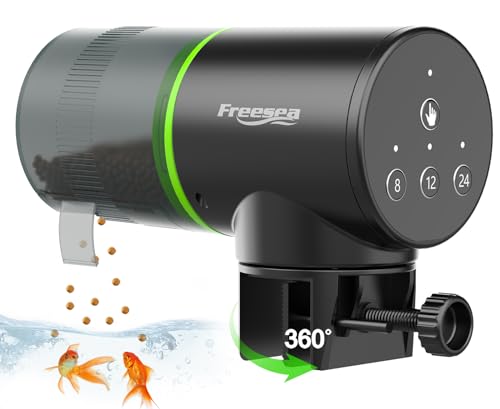
The FREESEA feeder provides flexible manual and automatic operation with set intervals of 8, 12, or 24 hours. It features an open design to add food without removing the timer unit and offers a 360° rotation for precise feeding. Its moisture-resistant design helps preserve freshness for various feed types, such as strips, powder, granules, and flakes. Ideal for small tanks, bettas, or turtle habitats where dependable schedule feeding matters during trips.
Petbank Automatic Fish Feeder for Aquarium

Petbank’s feeder emphasizes precise portioning with 16 individual grids, each holding up to 2 g, enabling multiple meals and variety in a single day. It offers two installation methods: adjustable clamp base for tanks or suction cup for covers. The fully sealed design minimizes moisture exposure to keep food dry, compatible with pellets, granules, powders, and strips. Note that it is not recommended for shrimps or flakes. This model suits households with multiple fish or varied feeding needs.
SYSENCIAGA Automatic Fish Feeder
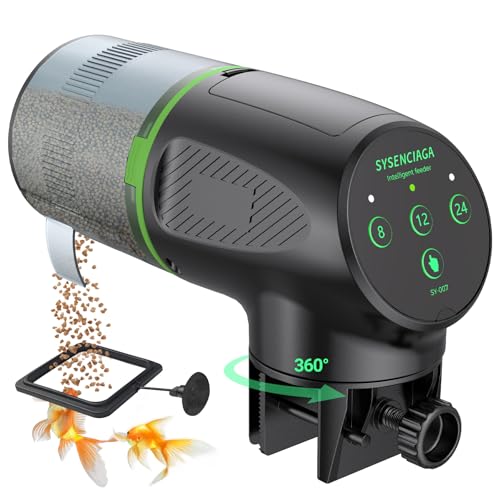
The SYSENCIAGA feeder combines manual and automatic modes with a 200 ml capacity. It supports 3 intelligent interval modes, including 8-hour, 12-hour, 24-hour, and 48-hour rotations, along with a manual feeding option. A moisture-proof cover helps prevent clumping and keeps foods like pellets, powders, granules, and flakes fresh. Suitable for a range of tanks from small bettas to larger community setups, and designed for ease of use during travel or busy days.
Pawfly Automatic Fish Feeder

The Pawfly feeder runs on two AA batteries and provides a practical solution for short absences with a 60 ml capacity. It enables up to two feedings per day on a default 12- or 24-hour cycle and includes a manual feeding option for flexibility. Battery-powered operation offers portability and longer runtime, typically extending several months between replacements, depending on feeding frequency. It’s a compact choice for small to medium tanks where simple operation matters most.
Buying Guide
When selecting an automatic fish feeder, consider capacity, power source, feeding frequency, and resistance to moisture. Higher capacity is beneficial for longer trips, but for small tanks, a compact model with precise portion control reduces waste and water quality concerns.
- Feeding modes and intervals: Look for programmable options such as 8h, 12h, 24h, and multiple feedings per day. Some models also include 48-hour cycles for extended trips.
- Portion control: A reliable feeder should offer adjustable portions to prevent overfeeding and water pollution. Check whether the design uses multiple small compartments or an adjustable slider.
- Moisture protection: Moisture-proof lids or fully sealed chambers help keep pellets and flakes dry, reducing clumping and spoilage.
- Power options: Battery-powered units provide portability and travel flexibility; others combine USB power with battery backup to handle outages.
- Mounting compatibility: Ensure the feeder fits your aquarium setup, whether on the tank rim, hood, or lid with suction or clamps.
- Ease of maintenance: Look for straightforward refilling, clear feeding windows, and easy cleaning to minimize disruption to the tank.
- Food type compatibility: Confirm the feeder supports the specific food type (pellets, granules, powders, or flakes) and tank inhabitants (fish, betta, or turtles).
Additional considerations include redundancy for power outages, user-friendly setup, and compatibility with larger tanks. For homes with multiple tanks or varying feeding schedules, a model with easy adjustability and clear documentation reduces the learning curve and helps maintain consistent feeding routines for aquatic pets.