The best dog ankle brace for a back leg depends on whether your dog needs hock coverage, a pair for both rear legs, or added side support. The Labra wraps are options for hock coverage in medium and large sizes; NeoAlly offers a short hock brace and a small pair; and the metal-strip brace is designed for added stability. These products support the hock, also called the ankle—not the knee. Check the product’s size guidance and ask your veterinarian whether a brace suits your dog’s condition.
| Product | Best suited for | Standout feature |
|---|---|---|
| Labra Medium | Dogs that fit the listed medium size | Hock coverage and wound protection |
| Labra Large | Dogs that fit the listed large size | Adjustable hind-leg support |
| NeoAlly Short Brace | Short-legged dogs needing hock support | Perforated neoprene and reflective straps |
| Metal-Strip Hock Brace | Dogs needing added side support | Sewn-in metal support springs |
| NeoAlly Small Pair | Dogs needing support on both hocks | Two braces with reflective straps |
Labra Rear Hock Wrap, Medium

This adjustable Labra wrap is designed for the rear hock joint, not the knee. The product description identifies support for weak back legs and joint discomfort, and says the wrap can cover open wounds. It is presented as an option for senior dogs and recovery situations.
Best for: Dogs that fit the medium size and need coverage around the hock. It was selected for its stated combination of joint support and wound coverage. Limitation: It does not fit the knee, so it is not the right choice when the affected area is the knee.
Labra Rear Hock Wrap, Large

The large version has the same stated purpose as the medium Labra wrap: supporting and protecting the rear hock, helping support a dog’s weight, and covering open wounds. The listing describes it as a potential aid for senior dogs and dogs recovering from an injury.
Best for: Dogs that measure into the large size and need a hock-focused wrap. Choose it over the medium version based on fit, not assumed support differences. Limitation: This is hock support, not knee support; confirm measurements before choosing a size.
NeoAlly Short Rear Hock Brace

NeoAlly describes this short rear-leg brace as hock and ankle support, including for short-legged breeds. Its listed materials include perforated neoprene and a nylon lining, and it has reflective straps. The listing says the material is breathable and intended to reduce pinching, rubbing, and chafing.
Best for: Owners seeking a short-style hock brace with reflective straps and breathable listed materials. It was selected for those specific design features. Limitation: The listing includes inconsistent wording about front-leg fit, so verify the intended placement and sizing with the seller before purchase.
Hock Brace With Metal Support Strips
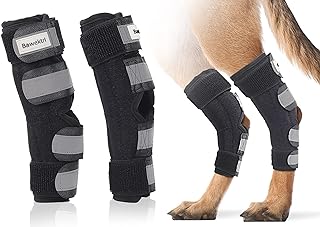
This rear hock brace has metal support springs sewn into each side, plus safety reflective straps. The listing describes compression and stabilization for hock-joint concerns, including arthritis, sprains, and recovery after surgery or injury. It specifically warns that the brace is for the ankle or hock, not the knee.
Best for: Buyers looking for a brace with listed side supports to help stabilize the hock. Limitation: The seller emphasizes using its size chart; a poor fit may undermine the intended support. The listing does not establish that the brace is suitable for every diagnosis or recovery plan.
NeoAlly Rear Hock Brace Pair, Small
This listing provides one pair of small braces for a dog’s rear hocks. Each brace has two reflective Velcro straps, which the seller says help secure it and reduce sliding. The product description presents a pair as a way to support both hocks when an injury on one side may affect balance.
Best for: Owners who need two small hock braces rather than a single brace. It was selected for its pair format and adjustable reflective straps. Limitation: It is not a knee brace. Confirm that both rear legs need support and that the small size is appropriate.
Buying Guide: How To Choose A Dog Hock Brace
Is the problem at the hock or the knee?
Identify the affected joint with your veterinarian before buying. A hock or ankle brace covers the lower rear-leg joint; the listed products do not claim to brace the knee. A brace intended for the wrong joint may not provide the support your dog needs.
Should you choose one brace or a pair?
A single wrap may suit a dog that needs coverage on one hock. A pair may be more practical when both rear hocks need support. Do not assume both legs require bracing because one is injured; ask a veterinarian whether bilateral use is appropriate.
How important is sizing and fit?
Use the size chart and measuring instructions for the specific product. The Labra options are listed in medium and large, while the NeoAlly pair here is listed as small. Check that straps can secure the brace without excessive tightness, slipping, or rubbing, and monitor your dog’s skin while it is worn.
Which features matter most?
- Choose a hock-specific design when the support area is the rear ankle joint.
- Consider reflective straps if visibility in low light is useful.
- Look for a pair if both hocks need support.
- Consider the metal-strip design only if its listed side supports suit the veterinarian’s recommendation.
- For wound coverage, check that the brace’s placement and fit are appropriate for the wound.
When should you ask a veterinarian?
Consult a veterinarian about a new injury, ongoing limping, swelling, pain, or post-surgical support. A brace is not a substitute for diagnosis or a recovery plan. Stop using it and seek advice if it causes rubbing, discomfort, or a change in how your dog walks.
Frequently Asked Questions
Is a dog ankle brace the same as a hock brace?
These listings use “ankle” and “hock” to describe the rear-leg joint the braces cover. They distinguish that area from the knee.
Can a hock brace support a dog’s knee?
No. The products described here are intended for the hock or ankle, not the knee. Ask a veterinarian about knee-specific support.
Can a brace be used on both back legs?
Some listings provide a pair. Use braces on both legs only if the size and fit are appropriate and a veterinarian recommends bilateral support.
How do I choose the right size?
Measure your dog according to the product’s instructions and compare the result with its size chart. Do not select a size based on breed alone.
Can these braces replace veterinary treatment?
No. They are support products, not a diagnosis or treatment plan. Consult a veterinarian for injuries, arthritis concerns, wounds, or recovery after surgery.