If you’re looking to keep your dog safely contained without a traditional tall fence, an in-ground or ground-installed boundary system can be a strong option. This guide highlights five practical choices, explaining who each is best for and why it stands out. It covers persistent pups, multi-dog households, first-time installers, and households needing yard-wide customization. The table below helps you compare at a glance.
| Product | Best For | Key Benefit |
|---|---|---|
| PetSafe Stubborn Dog In-Ground Fence | Persistent or hard-to-train dogs | Extends up to 25 acres with expandable wire; multiple correction levels |
| PetSafe Basic In-Ground Fence (Tone-Only) | First-time fence owners needing simple tone guidance | Tone-Only mode plus 4 static levels; expandable to 5 acres |
| PetSafe Basic In-Ground Fence, 2 Dog | Two-dog households seeking scalable options | Includes two collars; tone and static modes; expandable to unlimited collars |
| 45.33ft Animal Barrier Fence | Garden or yard boundary where digging is an issue | Rustproof metal panels; no-dig, temporary or semi-permanent use |
| No Dig Garden Fence, 10 Panels | Garden borders and decorative yard perimeters | Rustproof metal panels; easy setup for garden protection |
PetSafe Stubborn Dog In-Ground Fence

The PetSafe Stubborn Dog In-Ground Fence is designed for dogs that need a stronger boundary training approach. It uses a tone plus vibration, then four levels of static correction to match how a determined dog responds. The system includes 500 ft of wire for a 1/3-acre setup and can be expanded to cover up to 25 acres with additional wire. Best for owners with larger yards or dogs that require more robust correction during training. A potential limitation is that expansion requires purchasing additional wire and components, which can increase setup complexity and cost.
PetSafe Basic In-Ground Fence, Tone-Only
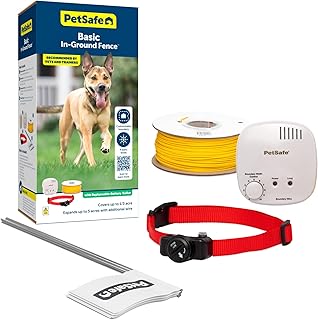
The PetSafe Basic In-Ground Fence with tone-only mode is a simpler entry point for yard containment. It includes 500 ft of wire capable of fencing in up to 1/3 acre, with upgradable reach up to 5 acres. It features four static correction levels in addition to the tone option, providing a gentle training path for most dogs. It’s a good pick for first-time installers who want straightforward setup and clear auditory cues, with the caveat that expanding beyond 5 acres requires more wire and planning.
PetSafe Basic In-Ground Fence, 2 Dog

With two collars included, this system suits households expanding to multiple dogs. It offers tone plus static modes and can grow to accommodate more dogs over time. Best for households planning growth or currently managing two canine companions. A potential limitation is that ongoing expansion depends on additional collars and compatible components.
45.33ft Animal Barrier Fence

This barrier fence is best for managing digging and creating a physical boundary without a buried wire system. It’s a practical solution when you want temporary or semi-permanent separation and a visible barrier in areas like gardens or patios. Limitations include that it is not an underground or electronic boundary system, so it does not train dogs to stay within a buried edge. It’s better for perimeter control rather than precise boundary training.
No Dig Garden Fence, 10 Panels

No Dig Garden Fence provides a flexible, no-duss boundaries option for garden areas and decorative beds. It uses rustproof metal panels that can be configured around landscapes to deter dogs from digging or crossing into restricted zones. Best for temporary or decorative fencing goals where an underground boundary isn’t required. Limitations include that it does not train dogs to stay within an underground boundary, and it may require more visual maintenance to blend with yard aesthetics.
Buying Guide: Key Considerations For Choosing The Right System
- Yard size and layout: Larger yards favor expandable wire systems; smaller spaces may benefit from tone-only or multi-dog options.
- Dog temperament: Persistent or hard-to-train dogs may need stronger correction options and more expandability.
- Number of pets: If you have multiple dogs, choose systems that include multiple collars or easily support additional collars.
- Installation style: DIY-friendly systems work well for flat, open yards; irregular landscapes might require more wire or different boundary strategies.
- Budget considerations: Wire length, additional collars, and boundary tags influence total cost; plan for expansion beyond initial setup.
- Safety and training approach: Tone, vibration, and static levels should be adjustable to your dog’s sensitivity and training progress.
Practical Comparison Questions
- What is the maximum boundary area for each system? Most basic setups cover up to 1/3 acre with wire expansions possible to several acres depending on the model.
- Can I train multiple dogs with a single system? Yes, certain models support additional collars and multiple dogs, but check compatibility and expansion limits.
- Are there options without underground wiring? Yes, some barrier fences provide physical boundaries without buried wiring, suitable for digging prevention.
- How long does installation take? DIY setups for 1/3 acre typically take a weekend, with expansion requiring additional components and time.
- What maintenance is required? Regular inspection of buried wire, collars, and boundary sensors ensures consistent performance.
Frequently Asked Questions
- Can these systems work for dogs with hearing impairment? Yes, some models combine tone and vibration to aid boundary learning.
- Is expansion always necessary for larger yards? Expansion is optional but recommended if you plan to fence larger areas beyond the initial setup.
- Do these systems require professional installation? Most are marketed as DIY installations, but professional help can simplify wiring or complex layouts.
- What if my dog learns to test the boundary? Start with the lowest correction level and gradually adjust as training progresses, ensuring safety.
- Are there risks of false activations? Ensure correct wire installation and check collars for proper fit to minimize false activations.