To feed fish while you’re on vacation, choose a slow-release block for simple trips or an automatic dispenser for scheduled, portioned meals. Tetra and Atlantic Rush offer blocks designed for up to 14 days; Aoyar and DXOPHIEX provide timed dispensing; Petbank is best suited to people who want individual stored portions. Match the method to your fish’s diet and feeding routine, then test it before leaving.
| Product | Feeding method | Best suited for |
|---|---|---|
| Tetra Vacation Food | Slow-release block | Tropical fish and trips up to 14 days |
| Aoyar Automatic Feeder | Timed dispenser | Large-capacity scheduled feeding |
| Atlantic Rush Vacation Feeder | Vacation block | 7- or 14-day block feeding |
| DXOPHIEX Automatic Feeder | Timed dispenser | Flexible mounting and backup power |
| Petbank Automatic Feeder | Individual meal portions | Precise portions and varied food types |
Tetra Vacation Food Slow-Release Feeder Block
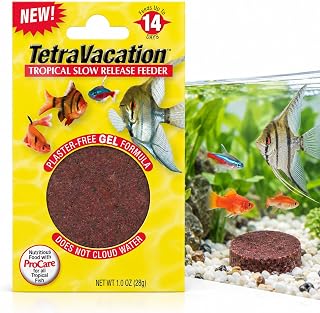
Best for: Tropical-fish owners seeking a low-maintenance option for an absence of up to 14 days. The gel block releases food as fish nibble, rather than dissolving on its own, and includes Tetra’s ProCare formula, which is described as supporting immune health.
Why it was selected: It offers a simple alternative to an electrically powered dispenser when the fish and trip duration fit the product’s stated use.
Limitation: Fish need to nibble on the block to access food. Confirm your fish will eat it before relying on it during a trip.
Aoyar Automatic Fish Feeder

Best for: Owners who want a 200-milliliter hopper and a recurring schedule. Its three stated intervals dispense food every 8, 12, or 24 hours, and a manual mode allows an additional feed. A slider adjusts the feeding amount.
The moisture-resistant lid is designed to reduce water vapor entering the food container and help limit clumping. This makes the model a useful choice for routine feeding while away, provided its schedule suits the fish.
Limitation: It offers fixed interval choices rather than a fully custom schedule. The product recommends feeding small fish every 24 hours, so check that the interval aligns with your aquarium’s routine.
Atlantic Rush Vacation Feeder Blocks

Best for: Fishkeepers who prefer a block and want a choice of 7- or 14-day feeding periods. The package contains two blocks, and the product states that it works without electricity or batteries. It is described for betta, goldfish, and tropical fish.
Why it was selected: The two duration options make it easier to choose a block based on trip length, while its battery-free format avoids setting up a powered feeder.
Limitation: A block does not provide the same adjustable meal portions as a dispenser. Check that this feeding format is suitable for your fish before leaving.
DXOPHIEX Automatic Fish Feeder

Best for: Aquarium owners who want scheduled feeding plus a backup power option. The feeder can run every 8, 12, or 24 hours, or dispense manually. It connects to home electricity using the included 6.6-foot USB cable or runs on two AA batteries, which are not included. Using both power sources allows battery backup if household power is interrupted.
Two mounting methods are listed: a tank-edge bracket for aquariums without a hood, or a funnel base for mounting on a tank hood. Choose this model if installation flexibility matters.
Limitation: You need to supply AA batteries if you want that backup option. Test the mounting setup and feeding amount in advance.
Petbank Automatic Feeder With Portion Control

Best for: Owners who prioritize measured individual meals. The feeder has 16 grids, with capacity for 15 individual meals; each grid holds up to 2 grams. It also has a sealed, moisture-resistant design that closes the opening after feeding.
Two installation methods are available: an adjustable clamp or a suction cup for the tank cover. The product lists particle feed, pellets, powders, and small strips as suitable food types.
Limitation: It is not intended for shrimp or flakes. Avoid this model if either is the food you need to dispense.
Buying Guide: How To Choose A Vacation Fish Feeder
Should you choose a block or an automatic dispenser?
A block is a straightforward option when its stated duration and feeding format suit your fish. An automatic dispenser is better when you want a recurring schedule or control over portions. A dispenser also requires you to check its setup, food compatibility, and power needs before departure.
How long will you be away?
Compare the planned absence with the product’s stated duration. Tetra lists feeding for up to 14 days, while Atlantic Rush offers 7- and 14-day options. Do not assume that a stated duration guarantees suitability for every aquarium or feeding routine.
Does the feeder handle your fish’s food?
Check food form before buying. Petbank specifically excludes flakes and shrimp, while the Aoyar description emphasizes adjustable dispensing and a moisture-resistant lid. Use the food your fish already accept, and trial the feeder with that food before traveling.
What should you test before leaving?
Set up the feeder early and observe several feeding cycles. Confirm that it is securely mounted, that food dispenses as intended, and that portions match the normal routine. For a powered model, review its listed power arrangement and any battery requirements.
Frequently Asked Questions
Can I leave fish unfed for a vacation?
That depends on the fish and the length of the trip. These products provide feeding options, but the supplied product details do not establish a safe fasting period for every species. Ask a qualified aquarium professional if you are unsure.
Are vacation feeder blocks suitable for every fish?
No single block should be assumed to suit every fish. Check the product’s stated species or use, and confirm your fish will eat the block before relying on it.
How often do automatic fish feeders dispense food?
The Aoyar and DXOPHIEX models list fixed 8-, 12-, and 24-hour intervals. Review the individual model’s settings and select a schedule that matches your aquarium’s established feeding routine.
Should I test a fish feeder before a trip?
Yes. Testing beforehand lets you confirm the schedule, food amount, mounting, and power setup while you can still make adjustments.