The best fish pond filter media depends on whether your filter needs to trap visible debris, support biological filtration, or do both. Cut-to-fit pads are practical for mechanical filtration, while bio balls provide surfaces for beneficial bacteria. The Koral Filters roll suits buyers who want reusable, customizable material; the Aquatic Experts bio balls are designed for high-flow pond systems; and the fine and coarse pads offer different particle-trapping options.
| Product | Best For | Media Type |
|---|---|---|
| Koral Filters Media Roll | Flexible, reusable filtration | Bonded filter pad |
| Aquatic Experts Fine Pad | Capturing smaller debris | Fine mechanical media |
| ALEGI Sponge Pad | Custom-sized sponge filtration | Foam media |
| Aquatic Experts Bio Balls | Biological filtration in high flow | Bio media |
| Aquatic Experts Coarse Pad | Capturing larger particles | Coarse mechanical media |
Koral Filters Cut-to-Fit Media Roll
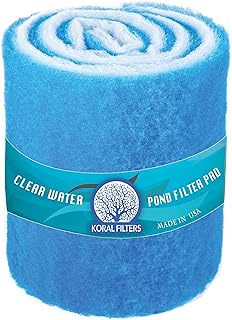
Best for: Pond owners who need a flexible pad that can be sized for different filter chambers. The roll measures 12 by 72 inches and can be cut for pond filters, waterfall filtration, circulation systems, or aquaponics setups.
Its bonded material is described as suitable for freshwater and saltwater environments, including koi ponds and aquariums. The manufacturer identifies it as mechanical filtration media for capturing impurities. It is also washable and reusable, which makes it a practical choice for buyers who want to clean and reuse their filter material.
Limitation: The roll must be measured and cut to fit the filtration system, and the product description does not specify a fine or coarse grade.
Aquatic Experts Fine Koi Pond Pad

Best for: Pond keepers who want a fine-grade pad for trapping particles such as uneaten food, fish waste, and decaying plant matter. It is designed for placement in flowing water, including a pond skimmer box, and is also described as suitable for aquariums.
This white polyester pad is approximately 3/4 to 1 inch thick and comes as a 12-by-72-inch bulk roll. Its cut-to-fit format lets buyers adapt it to their filter. The manufacturer says the material is bonded with resin for durability and recommends regular pad changes to remove trapped organic matter.
Limitation: A fine pad may require attention as it collects debris; plan to check and maintain it according to the pond’s conditions.
ALEGI Aquarium Sponge Filter Pad
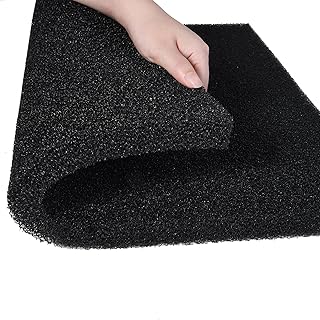
Best for: Buyers looking for cuttable foam media to fit an existing filtration system. The sponge’s high-density structure is intended to capture suspended particles, impurities, and waste through mechanical filtration.
The product is made from sponge material described as resistant to deformation, decomposition, and dissolution. Its customizable shape makes it useful when a standard pad size does not match the filter. Choose this option if you prefer sponge media and can determine the dimensions needed for your setup.
Limitation: The listing identifies this as an aquarium sponge pad, so buyers should confirm its dimensions and suitability for their specific pond filter before ordering.
Aquatic Experts Large Pond Bio Balls

Best for: Pond owners who need biological media for a waterfall or high-flow outdoor filter. The open-spine design provides surface area for beneficial bacteria, which help break down waste. Unlike a mechanical pad, these bio balls are primarily intended to support biological filtration.
The package contains 300 balls, each 1.5 inches across, and includes a mesh bag. The manufacturer’s guidance is 30 balls per 100 gallons, with the pack listed for ponds up to 1,000 gallons. The open structure is designed to let debris pass through and reduce clogging.
Limitation: Bio balls do not replace mechanical media when the goal is to trap visible particles. Size the quantity to the pond volume and filter space.
Aquatic Experts Coarse Pond Filter Pad

Best for: Pond owners who want a coarse, cut-to-fit pad for catching larger debris in flowing water. It is intended for koi ponds and can be placed in a skimmer box or other suitable filter area to capture food, waste, and plant matter.
This black pad measures 12 by 72 inches and is about 1 inch thick. Its rigid, latex-coated construction is described as durable, while the bulk-roll format allows custom sizing. Choose it over a fine pad when a coarser grade better matches the filter’s needs or when you want a material designed for pond use.
Limitation: Coarse media is not the same as fine media; it may not capture smaller suspended particles as effectively as a fine-grade pad.
Buying Guide: How to Choose Fish Pond Filter Media
Do you need mechanical or biological filtration?
Mechanical media physically traps particles. Filter pads and sponges are common choices for removing debris from water moving through a filter. Biological media, such as bio balls, provides surfaces where beneficial bacteria can live and help break down waste. Many pond systems use both types in the same filtration setup.
Should you choose fine or coarse pads?
Fine pads are intended to catch smaller particles, while coarse pads are suited to larger debris and can serve as a different filtration stage. Consider what the existing filter is designed to hold and how much debris enters the pond. A pad that catches more material may need regular inspection and cleaning or replacement.
How important are size and fit?
Measure the filter chamber before choosing a pad or roll. Cut-to-fit media provides flexibility, but it still needs to cover the intended area without obstructing water flow. For bio balls, check the filter compartment dimensions and use the manufacturer’s stated quantity guidance as a starting point.
What maintenance should you expect?
Mechanical media needs routine checks because trapped debris can build up. Reusable pads can be cleaned according to their product instructions. Biological media should be handled in a way that suits the pond’s established filtration routine. Follow the media maker’s guidance and monitor water conditions rather than relying on media type alone.
Frequently Asked Questions
Can I use aquarium filter media in a fish pond?
Some products are described for both aquariums and ponds, while others are listed for aquarium use only. Check the product description and confirm that the dimensions and intended use match your pond filter.
Are bio balls a replacement for filter pads?
No. Bio balls support biological filtration, while pads mainly trap physical debris. They perform different roles and can be used together when the filter system supports both.
How often should pond filter media be cleaned?
There is no single schedule for every pond. Check mechanical media regularly and clean or replace it when debris buildup affects its function. Follow the product instructions and account for the pond’s water flow and debris load.
How many bio balls do I need?
The listed Aquatic Experts guidance is 30 balls per 100 gallons. Its 300-count pack is described as treating up to 1,000 gallons, but buyers should also confirm that their filter has enough room for the media.