The best fish tank filter material depends on the debris you need to remove and the space available in your filter. For flexible, roll-style polishing media, Aquatic Experts and AQUANEAT offer large dual-density pads. ALEGI is a cut-to-size foam option, while MAQIHAN and Borlech provide compact pads for custom setups. These products are primarily described as mechanical filtration media: they capture particles from water rather than replace routine tank maintenance.
| Product | Best For | Format |
|---|---|---|
| Aquatic Experts FilterFirst | Large or varied filter layouts | Dual-density roll |
| ALEGI Sponge Pad | Custom-cut foam media | 20 PPI sheet |
| MAQIHAN Filter Pad | Freshwater or saltwater setups | Cut-to-size floss pad |
| Borlech 8-Layer Pad | Layered particle capture | Multi-layer pad |
| AQUANEAT Dual-Density Roll | Canisters, sumps, and other filters | Two-sided roll |
Aquatic Experts FilterFirst Floss Roll

This filter material is best for aquarium owners who want a large roll that can be cut to fit different filter compartments. The 12-inch-wide, 72-inch-long pad has two layers designed to catch large debris and finer particles. Its listed thickness is 3/4 to 1 inch, so check the available space in the filter before cutting a section.
The polyester fibers are described as durable and suitable for rinsing several times. Choose this option if you value a reusable, cut-to-fit format for a canister, sump, or hang-on-back system. Its main limitation is that the roll must be measured and trimmed to match the filter; it is not a pre-shaped cartridge.
ALEGI Cut-to-Size Sponge Filter Pad
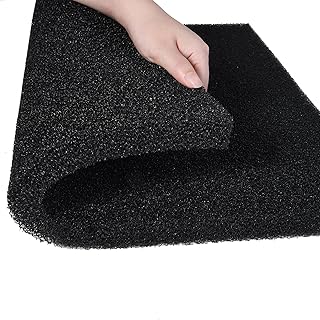
ALEGI is best for buyers who prefer foam over loose-looking filter floss and need a sheet they can shape themselves. The pad measures 20 by 20 inches and is 1 inch thick, with a listed 20 PPI structure. Its sponge material is described as capturing suspended particles and waste while resisting deformation, decomposition, and dissolution.
Cutting the sheet to size makes it adaptable to different filtration layouts. Choose it if a foam pad suits your filter’s media compartment. The limitation is that the large sheet needs to be cut accurately before installation, and the product information does not specify a dual-density design.
MAQIHAN Cut-to-Size Filter Pad

This white filter floss pad is best for aquarium keepers who want one cuttable material for freshwater or saltwater tanks. It measures 39.4 by 11.8 inches and is described as a high-density fiber pad with good water permeability. The listed uses also include ponds, water gardens, and turtle habitats.
Choose MAQIHAN if you need a polishing pad that can be trimmed for a specific filter or habitat. Its stated permeability is intended to support water flow while capturing impurities and sediment. A limitation is that this is a single white pad rather than a roll with clearly differentiated coarse and fine sides.
Borlech 8-Layer Aquarium Filter Pad

Borlech is best for buyers seeking a compact, layered pad rather than a long roll. The 15.75-by-11.81-inch pad is 0.6 inch thick. Its listed construction combines honeycomb mesh cloth, fiber biochemical cotton, and non-adhesive nano-filter mesh to capture particles such as fish waste and uneaten food.
The product is described as reusable after proper cleaning and designed to withstand regular water flow. Choose it if its layered format and dimensions suit your filter, sump, or pond setup. Its limitation is its fixed sheet size: larger compartments may require more than one piece, while smaller ones require trimming.
AQUANEAT Dual-Density Filter Floss Roll

This roll is best for fish keepers who want coarse and fine mechanical filtration in one cut-to-fit pad. It measures 72 by 12 inches and is 3/4 to 1 inch thick. The white side has an open fiber construction for larger particles, while the green side has a denser fiber network for finer particles.
It can be cut for use as a pre-filter in canister, sump, wet/dry, or power-filter setups. Choose AQUANEAT if you want a clearly identified two-sided design and a long roll. Check the filter compartment’s clearance first because the listed thickness may not fit every media slot.
Buying Guide: How to Choose Fish Tank Filter Material
Do you need floss or foam?
Filter floss is a practical choice for catching suspended particles and polishing water. Foam provides a thicker, sheet-style option that can be cut to fit. Compare the product dimensions and thickness with your filter’s media compartment before buying; a material that is too large may need trimming, and a thick pad may not fit.
Would dual-density or layered media help?
Dual-density pads have distinct fiber constructions for larger and finer particles. Aquatic Experts and AQUANEAT list this type of design. Borlech uses several layers of different materials. A simpler single pad, such as the MAQIHAN option, may suit buyers who prioritize a straightforward cut-to-size sheet.
How important is reuse?
Some listed products are described as reusable or rinseable, including the Aquatic Experts and Borlech pads. Follow the product’s care directions and inspect media during maintenance. The provided information does not give a fixed replacement schedule, so condition and your aquarium’s needs should guide upkeep.
Does mechanical media replace other maintenance?
No product description here establishes that these pads replace water changes or other aquarium care. These materials are presented mainly for mechanical particle capture. Choose filter material based on your filter layout and the kind of debris you want it to catch.
Frequently Asked Questions
What does fish tank filter material do?
Mechanical filter material catches particles and debris as water passes through it. The products here describe capturing waste, sediment, or suspended particles.
Can aquarium filter pads be cut to fit?
Yes. All five products are described as cut-to-size or cut-to-fit media. Measure the filter compartment before trimming.
Which option has two densities?
Aquatic Experts and AQUANEAT both describe dual-density filter material, with different fiber structures for larger and finer particles.
Can these materials be used in saltwater tanks?
MAQIHAN specifically lists freshwater and saltwater use. The other product details do not clearly state saltwater suitability, so check their product information for your setup.
How often should filter material be cleaned or replaced?
The product information does not provide a universal schedule. Check the material regularly and follow the manufacturer’s care instructions for rinsing or replacement.