Choosing the right heater for a 30-gallon tank ensures stable temperatures and healthier aquatic life. This guide highlights five reliable options and compares their features, compatibility with freshwater and saltwater setups, and safety considerations. Each product is evaluated for performance, durability, and ease of use to help hobbyists make an informed choice for mid-sized aquariums.
| Product | Wattage | Tank Range | Key Benefit |
|---|---|---|---|
| Fluval M 100-Watt Submersible Heater | 100W | Up to 30 gallons | Compact, reliable, aesthetically unobtrusive |
| Orlushy 150W Submersible Heater | 150W | 20-30 gallons | Quartz glass, compact, good for mid-sized tanks |
| Orlushy 100W Submersible Heater | 100W | 10-20 gallons | Budget-friendly, compact, easy to hide |
| SEAOURA 200W Heater | 200W | 30-40 gallons | High/low protection, external controller |
| Tetra 100-Watt Submersible Heater | 100W | 10-30 gallons | Electronic thermostat, simple indicator |
Fluval M 100-Watt Submersible Heater

Designed for aquariums up to 30 gallons, the Fluval M 100-Watt Submersible Heater offers precise temperature control with a compact, sleek profile. Built with European components, it emphasizes reliability and consistent performance. Its reflective finish helps it blend into the tank while maintaining a minimal footprint, making it a favorable option for neatly arranged setups. Suitable for both fresh and saltwater environments, it provides dependable heating without drawing attention.
Orlushy 150W Submersible Heater

The Orlushy 150W heater is recommended for 20-30 gallon tanks. It features a compact 9.5-inch design and a 6-foot power cord for flexible placement. The heater includes a temperature adjustment area and is built with 2mm thick quartz glass for improved safety and durability in both freshwater and saltwater tanks. It is easy to hide within the aquarium decor while providing steady heat distribution and reliable operation.
Orlushy 150W Submersible Heater with Digital Display

This 150W model includes an external controller with a digital display and overheat protection, designed for 20-30 gallon freshwater and saltwater tanks. Its gray quartz glass construction enhances safety, resistance to high temperatures, and durability. The unit quickly heats water while the integrated sensing system maintains the set temperature, helping to prevent drastic fluctuations that stress aquatic life.
SEAOURA Aquarium Heater, 200W
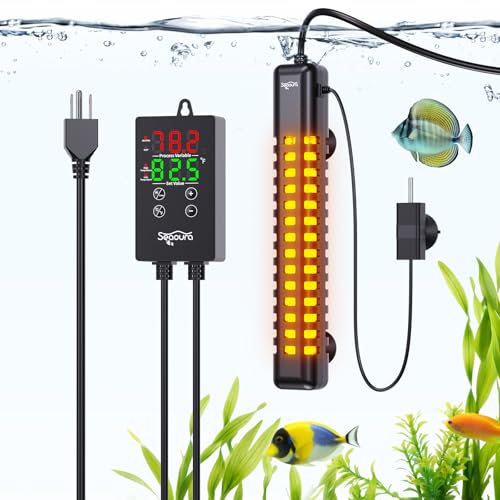
The SEAOURA 200W heater is suited for 30-40 gallon tanks, utilizing an external controller and a temperature probe for precise readings. It includes high/low temperature protection and an alarm, helping to avoid overheating and alerting you to potential issues. The design supports safer operation by ensuring the heater adjusts power output to maintain a stable tank temperature, which is especially important for sensitive species in mid-sized aquariums.
HITOP 50W Adjustable Aquarium Heater

The HITOP 50W heater is designed for small tanks up to 15 gallons, with a 7.2-inch length and a 4.9-foot cord. While not ideal for larger tanks, it demonstrates a scalable approach to temperature control with robust safety features, including a 2mm thick quartz glass body and automatic on/off cycling within the 68–93 °F range. It is a suitable option for compact communities or fry tanks adjacent to larger displays.
Buying Guide: Key Purchase Considerations
Choosing the right heater involves evaluating tank size, water type, and the needs of resident species. Consider wattage relative to gallon capacity; oversizing can lead to rapid temperature swings if the thermostat overcompensates, while undersizing may fail to maintain warmth in colder environments. Look for reliable thermostats with precise regulation, clear indicators, and interchangeable safety features such as overheat protection and automatic shutoff.
Safety and durability are essential. Quartz glass heaters with explosion-proof construction reduce the risk of leaks and breakage in active tanks. A compact form factor helps to minimize intrusions into the aquascape, especially in densely planted or heavily stocked setups. When selecting an external controller or digital display, ensure compatibility with your tank’s environment and your monitoring routine.
Ease of use and maintenance also matter. Heaters with clear temperature readouts and straightforward adjustment mechanisms save time during routine checks. Consider whether the device is suitable for both freshwater and saltwater, since saltier water can accelerate corrosion in lesser-rated components. Proper placement, tip protection from substrate, and regular inspections will extend heater life and maintain stable conditions for your aquatic life.
Lastly, budget considerations should balance upfront cost with long-term reliability. While higher-w wattage units or models with advanced controllers may incur a higher initial price, they frequently offer better stability and safety features that reduce risks to tank inhabitants, which is especially important for 30-gallon systems housing sensitive species or mixed communities.