Answering the need for reliable, submersible filtration, these internal fish tank filters are designed for small to medium aquariums. They suit beginners who want easy maintenance, hobbyists seeking quiet operation, and feeders who want dependable water quality without bulky external gear. Below are five well-rounded options with clear reasons to choose each one, plus a compact buying guide and FAQ to help you decide.
| Product | Approximate Flow (GPH) | Best For | |
|---|---|---|---|
| Tetra Whisper Internal Power Filter (Medium) | 5–10 gallons | 85 GPH | Small bowls or nano tanks; quiet, easy cartridge changes |
| NICREW Aquarium Internal Filter | 5–10 gallons | 53 GPH | Budget-friendly, reliable basic filtration with aeration |
| Tetra Whisper Internal Power Filter (Large) | 10–30 gallons | 135 GPH | Mid-size tanks needing higher turnover |
| BlueYu 4-in-1 Internal Filter | 30–80 gallons | Up to 200 GPH | Verse tank setups with adjustable oxygenation and quiet operation |
| AquaMiracle 3-Stage In-Tank Filter | 10–40 gallons | 130 GPH | Three-stage filtration with visible media and safety features |
Tetra Whisper Internal Power Filter (Medium) — 5–10 gal
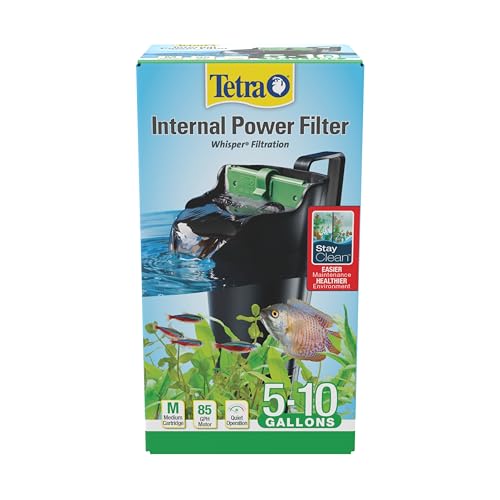
The Tetra Whisper Internal Power Filter for 5–10 gallon tanks uses medium Whisper BioBag filter cartridges that are easy to swap. Its quiet 85 GPH motor provides dependable turnover, while the cartridge floss traps debris and fish waste. Ultra-activated carbon helps remove odors and discoloration, improving overall water clarity. Best for small setups where quiet operation matters and simple maintenance is desirable. Caution: cartridge replacement frequency depends on bio-load; overloading may reduce filtration efficiency.
Tetra Whisper Internal Power Filter (Large) — 20–40 gal

This model targets mid-to-large small aquariums up to 40 gallons with a 200 GPH motor, delivering stronger filtration in a compact form. It uses large Whisper BioBag cartridges for easy changes and keeps water clear by passing flow through floss media and charcoal. Best for hobbyists who need higher flow without external canisters. Choose this if your tank has higher waste load; avoid if you have extremely small tanks where flow might be excessive.
NICREW Internal Filter — 5–10 gal

The NICREW internal filter emphasizes biological and chemical filtration with activated carbon and fine filter foam. It provides gentle 53 GPH flow and can generate extra air bubbles for oxygenation. Best for small tanks where a simple, quiet, and energy-efficient unit is preferred. It’s a good fit for basic community tanks; potential limitation is lower flow compared with higher-capacity models.
TARARIUM 55–150 Gal Internal Filter

This 4-in-1 internal filter offers crystal-clear filtration with a biochemical sponge to reduce odors and yellowing. It claims strong 300 GPH performance, making it suitable for larger community tanks or tanks with higher bioload. Best for those who want multi-functional operation (filtration, water movement, and aeration) in a space-saving package. Limitation: internal units may require more regular sponge maintenance to maintain efficiency.
Pawfly Internal Aquarium Filter — 3 to 10 gal

The Pawfly model provides 55 GPH with a 3 W pump and two outlet options for flexible water circulation. It’s designed for tiny to small fish tanks (3–10 gallons), making it ideal for desktop setups or shrimp tanks where space is at a premium. Best for budget-minded buyers who want adjustable flow in a compact unit; avoid if you require higher flow in larger tanks.
AquaMiracle 3-Stage In-Tank Filter

The AquaMiracle filter provides 3-stage filtration with coarse, carbonized, and fine sponge blocks. Max flow is around 130 GPH, and it’s designed for tanks between 10 and 40 gallons. It includes a transparent housing for easy media checks and dual water outlets for enhanced circulation and aeration. Best for aquariums needing visible media and reliable odor control; limitation includes medium lift height and the need to monitor sponge wear over time.
Buying Guide: Key Considerations for Internal Filters
How much flow do you need?
Match the filter’s GPH to your tank size and bioload. A rule of thumb is 4–6 times weekly turnover for community tanks, higher for messy eaters or larger fish. For 5–10 gallons, 50–120 GPH is often sufficient; for 20–40 gallons, aim for 100–200 GPH.
Filtration stages and media
Three-stage systems with mechanical, chemical, and biological media capture debris, odors, and ammonia byproducts. Look for units with replaceable media and clear indication of media types. In-tank visibility helps you know when media is dirty and needs replacement.
Noise and energy use
Quiet operation matters for bedrooms or offices. Check decibel levels if listed and look for energy-efficient motors. Internal filters are generally quieter than hang-on-back or canister models, but flow rates can influence noise depending on installation.
Tank compatibility
Choose a filter sized for your tank’s maximum volume and consider any special needs, such as airation or wave-making. Some models offer adjustable flow or aeration features to enhance gas exchange in tropical setups.
Maintenance and accessibility
Consider ease of cartridge changes, availability of replacement media, and how often you need to clean the impeller or sponge. Internal units should allow quick cartridge swaps and straightforward media checks to minimize aquarium downtime.
Best practices for selection
- For small tanks (5–10 gal): prefer models with around 50–100 GPH and simple cartridge replacements.
- For mid-size tanks (10–30 gal): look for 100–180 GPH and larger media capacity.
- For large or heavily stocked tanks (30–80 gal): prioritize higher flow and multi-stage filtration with robust media.
FAQ
- What is the advantage of an internal filter over an external one?
- How often should I replace filter media?
- Can these filters aerate the water?
- Are higher GPH always better?
- Do internal filters require special maintenance?
- Which filter should I pick for a 20–40 gallon tank?
Internal filters are compact, easy to install, and generally quieter. They are well-suited for small to mid-sized tanks and require less space behind or under the aquarium.
Follow the manufacturer’s guidance, typically every 2–4 weeks for activated carbon media, and replace mechanical media as it becomes visibly dirty. Biological media can last longer but should be rinsed gently when clogged.
Some units include air outlets or boost water movement that promotes aeration. Check product features for aeration capabilities if this matters for your tank inhabitants.
Higher flow improves filtration but can stress delicate fish in small or densely planted tanks. Choose a unit with adjustable flow when possible to tailor turnover to your tank.
Yes, periodic cleaning of media, impellers, and tubing is needed to maintain efficiency. Always unplug the unit before maintenance and avoid using tap water on beneficial bacteria if possible.
Consider models with 100–200 GPH and multi-stage filtration, such as the large-capacity Tetra Whisper or AquaMiracle options, to ensure adequate turnover and odor control.