The best media reactor setup for a reef tank centers on reliable up-flow filtration, compatibility with carbon, GFO, and bio-pellet media, and easy maintenance. This guide highlights five top options suited for marine hobbyists seeking clear water, controlled nutrient levels, and flexible media choices. Each option targets different reef-keeping needs—from compact systems to higher-capacity setups—so you can pick the best fit for your tank size and maintenance routine.
Below is a quick comparison of the selected products to help you decide at a glance. All five are suitable for saltwater reef tanks, but each has its strengths depending on media type, flow, and size.
| Product | Best For | Media Type | Flow Range (approx.) |
|---|---|---|---|
| Two Little Fishies ATLPBR150 GFO PhosBan Reactor 150 | Medium reef tanks needing efficient GFO | PhosBan (GFO) or similar media | 20–30 gal/hr |
| AQUATOP MR-30 Media Reactor | Sump or hang-on setups needing upgrade | Carbon, phosphate sponges, resins | Variable via pump |
| AquaReady FR-1E Media Reactor | Carbon, GFO, or biopellets with up-flow design | Carbon, GFO, Biopellets | Low to moderate flow |
| AQUATOP MR-20 Media Reactor | Compact, lightweight reef tanks | Phosphate sponges, carbon, resin-based media | Up-flow design, stable flow |
| Innovative Marine Minimax Pro Series Media Reactor | Small to midsize reef systems needing compact form | Any media you choose | Responsive flow control |
Two Little Fishies ATLPBR150 GFO PhosBan Reactor 150

Best for mid-sized reef systems prioritizing efficient GFO filtration. This reactor is designed to handle up to 200 grams of PhosBan with a media height of about 5 inches and is suitable for tanks up to 150 gallons when used alone. The recommended flow rate is approximately 20–30 gallons per hour to avoid grinding the media. Best used when phosphate control is a primary goal, and when the user wants a dedicated GFO stage that is straightforward to manage. A limitation is that too much flow can degrade the GFO efficiency by reducing contact time.
AQUATOP MR-30 Media Reactor

Best for larger reef setups or when you want a flexible upgrade path. The MR-30 is an up-flow filtration system compatible with carbon, phosphate sponges, and resin-based media. It includes AQUATOP’s SWP-360 submersible pump and a recessed O-ring lid for quick access and media changes. This model is better for users who want a larger capacity or a system that can be easily adjusted to different media types. A caution: ensure the pump flow matches media type to prevent channeling or reduced contact time.
AquaReady FR-1E Fluidized Up Flow Media Reactor

Best for flexible filtration with multiple media choices. The FR-1E supports carbon, GFO, and biopellets, with a total capacity of roughly 6.7 cups of media. Its up-flow design enhances contact time, pushing water from the bottom through the media and back into the tank. Inlet and outlet support 1/2″ or 3/4″ tubing. This model suits reef keepers who want customizable filtration and a compact footprint. One limitation is that media loading must be balanced to avoid reduced flow in small setups.
AQUATOP MR-20 Media Reactor
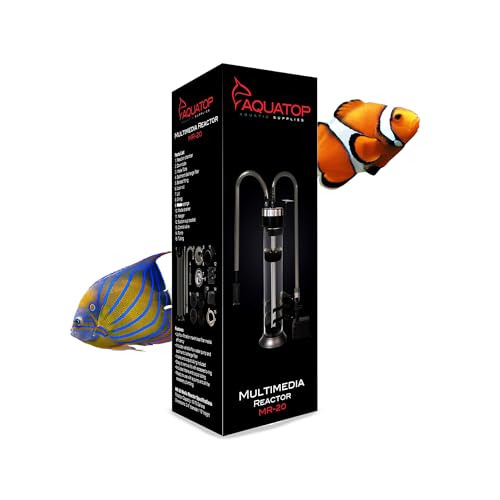
Best for compact reef tanks requiring reliable up-flow filtration. The MR-20 is designed for use with phosphate sponges, carbon, and resin-based media. It comes with AQUATOP’s SWP-230 submersible pump to maintain steady flow and a durable acrylic housing with a recessed O-ring lid for easy access. Choose this if you want a small but capable reactor that still supports multiple media types. Limitation: smaller capacity means more frequent media changes in higher nutrient systems.
Innovative Marine Minimax Pro Series Media Reactor

Best for small to midsize reef tanks needing a compact, efficient filtration option. The Minimax Pro features a small form factor with a high-quality cell cast acrylic body and a bracket for mounting. It provides responsive flow control and low power consumption. Best used when space is at a premium and you want a simple, scalable filtration solution. A potential limitation is that its compact size may limit the total media capacity for heavily stocked tanks.
Buying Guide
What media will you run in your reactor? Choose based on your reef goals—GFO for phosphate reduction, carbon for clarity, or biopellets for nutrient control. Consider the tank size and how many reactors you need. For larger tanks, a higher-capacity unit like the MR-30 offers flexibility and easier maintenance.
Is up-flow design important to you? Up-flow designs improve contact time between water and media, which is beneficial for filtration efficiency. If space is tight, look for a compact unit with an integrated pump.
What about flow rate management? A reactor should provide stable, controllable flow. Avoid units that require external pumps with inconsistent output, unless you plan to tune flow precisely to prevent media turnover or grinding.
How easy is maintenance? Detachable canisters, quick-access lids, and clear labeling help reduce maintenance time. A detachable canister (like the Sigma-1) keeps the pump stationary and simplifies media changes.
Tank compatibility and future needs. Start with a reactor that matches your current aquarium size but allows for growth. Modular options, like separate media stages, let you add or swap media as your reef evolves.
FAQ
- What is a media reactor used for in a reef tank? It filters water by circulating it through media such as carbon, GFO, or biopellets to remove impurities, nutrients, and organic compounds.
- Which reactor is best for a small nano reef? A compact unit like the Innovative Marine Minimax Pro is well-suited for space-constrained tanks while supporting essential media options.
- Should I use one or multiple reactors? For finer control, multiple reactors can isolate media types (GFO, carbon, biopellets). A single, larger unit can handle several media types but may require more careful maintenance.
- How do I prevent media from grinding in a reactor? Set the flow rate to the manufacturer’s recommended range. Too much flow reduces contact time and can grind the media.
- Can these reactors work with both saltwater and freshwater setups? Yes, most listed reactors are compatible with both, but reef tanks particularly benefit from reactors designed for stable, low-flow operation with carbonate, carbon, or phosphate media.
- Is cleaning a detachable canister necessary? Regular cleaning helps avoid clogging and maintains efficient flow. Detachable designs simplify access and reduce disruption to the tank.