The best shock collar electric fence depends on whether you need a set boundary around your property or a handheld remote for training. The PetSafe in-ground collar is best for adding a dog to a compatible wired system, while PetSafe’s wireless system suits buyers who want a circular boundary without buried wire. A GPS collar offers custom mapped boundaries; remote-only training collars do not create an automatic fence.
| Product | Best Suited For | Boundary Type |
|---|---|---|
| PetSafe Ultralight Collar | Adding a pet to a compatible in-ground system | In-ground system receiver collar |
| PetSafe Wireless System | Wire-free yard containment | Circular wireless boundary |
| Lilyeel GPS Collar Fence | Custom outdoor boundary mapping | GPS polygon boundary |
| PAWPRO Remote Training Collar | Remote training at a distance | No automatic fence stated |
| MAISOIE Training Collar | Basic remote training modes | No automatic fence stated |
PetSafe Ultralight In-Ground Fence Collar

Best for: Households that already use a compatible PetSafe in-ground fence and need a receiver collar for another pet. The product is designed to add pets to a system, and its listed features include a sound-only training mode and four static correction levels.
The receiver is waterproof and has a low-battery indicator. PetSafe states that it is compatible with its in-ground systems except YardMax and UltraSmart models. This compatibility detail makes it a focused add-on choice rather than a complete containment system.
Limitation: It is not a stand-alone fence; it requires a compatible in-ground system. Avoid this option if you use one of the excluded systems or need a complete setup.
PetSafe Wireless Pet Containment System

Best for: Buyers who want a wireless containment boundary and do not want to bury wire. The system’s adjustable circular range covers up to half an acre from the indoor transmitter, and the listing says coverage can be expanded with an additional transmitter.
Its boundary is circular, making it a better match for open yards where that shape works. The product description says the setup avoids digging and wire burial and can be configured in a few hours. It is intended to guide a dog back toward the play area at the boundary.
Limitation: The stated coverage is circular, not a custom property outline. Choose another approach if your yard shape or obstacles make a circular boundary unsuitable.
Lilyeel GPS Wireless Dog Collar Fence

Best for: Owners seeking a wire-free, custom-mapped boundary for outdoor use. Its listed features include a smartphone app for drawing a polygon boundary, alerts by beep, vibration, or shock, and no monthly subscription fee according to the product description.
The system also includes a remote for initial training. The listing recommends teaching the dog to associate beep and vibration with boundary limits before enabling independent GPS fence mode. The remote can train up to two dogs when a second collar is used.
Limitation: The listing specifies outdoor use with a stable GPS signal. It may not suit locations where GPS reception is unreliable, and the described fence depends on the mapped GPS boundary.
PAWPRO Remote Training Collar

Best for: Owners who want a handheld remote training collar rather than an automatic property fence. The product name lists a claimed four-mile range, night-light mode, 124 training levels, beep, vibration, and shock modes, plus a rechargeable waterproof collar and included training guide.
These features may suit buyers comparing remote training options and seeking multiple modes. However, a remote collar requires the handler to operate the remote; the supplied details do not describe an automatic boundary or fence function.
Limitation: Do not choose it as a substitute for an electric fence if you need a collar that automatically responds to a property boundary.
MAISOIE Waterproof Remote Training Collar
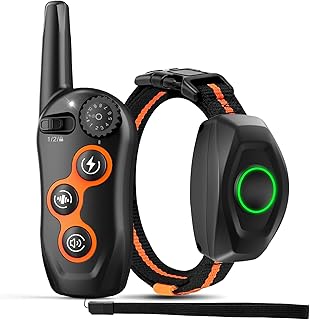
Best for: Buyers comparing a straightforward remote trainer with three listed modes: beep, shock, and vibration. The product name also identifies IPX7 waterproofing, rechargeable operation, a stated 1,300-foot remote range, and suitability for small, medium, and large dogs.
Choose this if you want a remote-controlled training collar with those stated modes and range. Like the PAWPRO model, it is not presented in the supplied product details as an automatic electric fence, so it should not be treated as a boundary system.
Limitation: The listed range and training modes describe remote use, not automatic containment. Select a dedicated fence product when hands-free boundary alerts are essential.
Buying Guide: How To Choose A Shock Collar Electric Fence
Do you need a fence or a training collar?
An electric fence system detects when a dog approaches a set boundary and triggers a collar response. A remote training collar is controlled by a person with a transmitter. These are different products: remote range does not mean the collar creates a property boundary.
Which boundary type fits your yard?
Choose an in-ground setup if you need a boundary laid out with a compatible wired system. Choose a wireless system if its circular coverage suits your property. Consider GPS mapping for a custom polygon outdoors, while accounting for the product’s stated need for a stable GPS signal.
What correction and training features matter?
Compare sound or beep, vibration, and static or shock options. A sound-only or vibration step can be useful during a gradual training approach, but follow the system’s instructions and observe your dog’s response. Do not assume correction levels or modes are equivalent across brands.
What should you verify before purchase?
- Confirm whether the item is a complete fence, an add-on receiver, or a remote trainer.
- Check system compatibility, boundary shape, and stated coverage against your yard.
- Review waterproofing, battery indicators, charging details, and multi-dog requirements as listed for the exact model.
- Plan supervised training; a containment collar is not a substitute for supervision or a physical barrier where one is needed.
Frequently Asked Questions
Is a shock collar the same as an electric fence collar?
No. A fence collar responds to a boundary system, while a remote shock collar is activated by a person using a transmitter.
Can a remote training collar keep a dog inside a yard automatically?
Not based on the listed features of the remote-only products here. Choose a product specifically described as a containment fence for automatic boundary response.
Does the PetSafe Ultralight collar include the whole fence?
No. It is an add-a-dog receiver collar for compatible PetSafe in-ground systems, with stated system exceptions.
Is wireless coverage always shaped like a yard?
No. The PetSafe wireless system described here uses a circular range. The Lilyeel product instead lists a custom polygon GPS boundary.
Should I use the correction mode immediately?
Follow the product’s training directions and introduce boundary cues gradually under supervision. The Lilyeel listing specifically recommends remote training before enabling its independent GPS fence mode.