Maintaining excellent water quality is essential for the health and longevity of freshwater fish. A reliable test kit helps you monitor pH, ammonia, nitrite, nitrate, and other key parameters to prevent stress and disease. This guide reviews five highly relevant test kits to help you choose the right tool for your tank size, inhabitants, and maintenance routine.
| Product | Brand | Key Parameters |
|---|---|---|
| API Freshwater Master Test Kit 800-Test | API | pH, High Range pH, Ammonia, Nitrite, Nitrate |
| API GH & KH Test Kit | API | GH, KH |
| Tetra EasyStrips 6-In-1 | Tetra | Nitrates, Nitrites, Hardness, Chlorine, Alkalinity, pH |
| Pawfly 5-in-1 Master Test Kit | Pawfly | pH, Nitrite, Nitrate, Ammonia, Phosphate |
| API 5-in-1 Test Strips | API | pH, Nitrite, Nitrate, Carbonate, General Hardness |
Below are five selected products most relevant to the query, covering liquid-test kits and test strips to fit different user preferences and tank setups. Each entry includes quick notes on accuracy, ease of use, and scope to help you compare options at a glance.
API Freshwater Master Test Kit

The API Freshwater Master Test Kit provides a comprehensive set to monitor five vital water parameters in freshwater aquariums: pH, high range pH, ammonia, nitrite, and nitrate. The kit includes seven bottles of testing solutions, a color card, and four tubes with caps, enabling accurate, repeatable readings. This reliability supports proactive maintenance and helps prevent invisible water problems that can stress or harm fish.
API GH & KH Test Kit

This kit focuses on general hardness (GH) and carbonate hardness (KH), two critical parameters for buffering capacity and mineral balance in freshwater tanks. By tracking GH and KH, aquarists can prevent pH swings and support stable, healthy water chemistry for fish and planted tanks alike. It includes two bottles of testing solution and two test tubes with caps for straightforward, repeatable tests.
Tetra EasyStrips 6-In-1

Tetra EasyStrips offer a convenient 6-in-1 strip test that covers nitrates, nitrites, water hardness, chlorine, alkalinity, and pH. These strips are designed for quick checks without the need for reagents, making them ideal for busy hobbyists who want regular at-a-glance readings. They are versatile for both freshwater and saltwater setups and provide color-chart comparisons for fast interpretation.
Pawfly 5-in-1 Master Test Kit

The Pawfly 5-in-1 Master Test Kit measures pH, nitrite, nitrate, ammonia, and phosphate in freshwater and marine tanks. It emphasizes high-accuracy liquid reagents for reliable results and uses color-matching charts to help hobbyists interpret readings quickly. The kit is designed to support stable tank conditions and timely corrective actions when parameters drift from desired ranges.
API 5-in-1 Test Strips
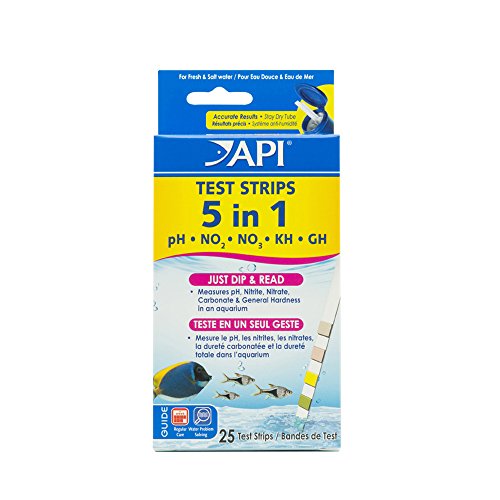
These API test strips cover five key parameters—pH, nitrite, nitrate, carbonate, and general hardness—in a single strip format. Dip-and-read simplicity makes them a popular choice for hobbyists who want quick, routine checks without a lot of setup. They are suitable for both freshwater and saltwater applications and integrate with widely used color charts for interpretation.
Buying Guide: Key Purchase Considerations
When selecting a freshwater test kit, consider the following factors to match your tank needs and maintenance style:
- Test type: Liquid reagent kits tend to offer higher accuracy and consistency, especially for parameters like ammonia, nitrite, and nitrate. Strips are faster and simpler but can be less precise in marginal ranges.
- Parameters covered: Most hobbyists focus on pH, ammonia, nitrite, and nitrate. If your tank has live plants or specific fish, GH and KH or phosphate readings may matter more for buffering and mineral balance.
- Tank size and inhabitants: Larger tanks or those with sensitive species benefit from more comprehensive testing (5-in-1 or 7-parameter kits). Small, lightly stocked tanks may be adequately served by simpler strips.
- Frequency: Regular testing—often twice weekly or after changes—helps detect issues early. Kits with faster readouts can encourage more frequent checks.
- Ease of interpretation: Color charts, step-by-step instructions, and clear labeling reduce user error. Look for kits with easy-to-read instructions and reliable color scales.
- Maintenance and storage: Consider the shelf life of reagents, especially in heat and humidity. Kits with sealed vials and long expiry dates reduce replacement frequency.
- Cost per test: While upfront cost matters, also examine the long-term cost per test, including the number of tests provided and the need to replace reagents.
- Tank maturity: New tanks are more prone to ammonia spikes; begin with a kit that gives early insight into ammonia and nitrite, then monitor slowly as the biofilter establishes.
- Compatibility: Some brands offer both liquid reagents and strips. Ensure you follow the manufacturer’s instructions for best results in your tank type.
In practice, a balanced approach often combines a master liquid kit for a full parameter set with quick strips for routine checks. For beginners, starting with a two-in-one strategy—master kit for weekly confirmation and strips for daily or every-other-day checks—can ease acclimation while providing reliable data on water quality trends.